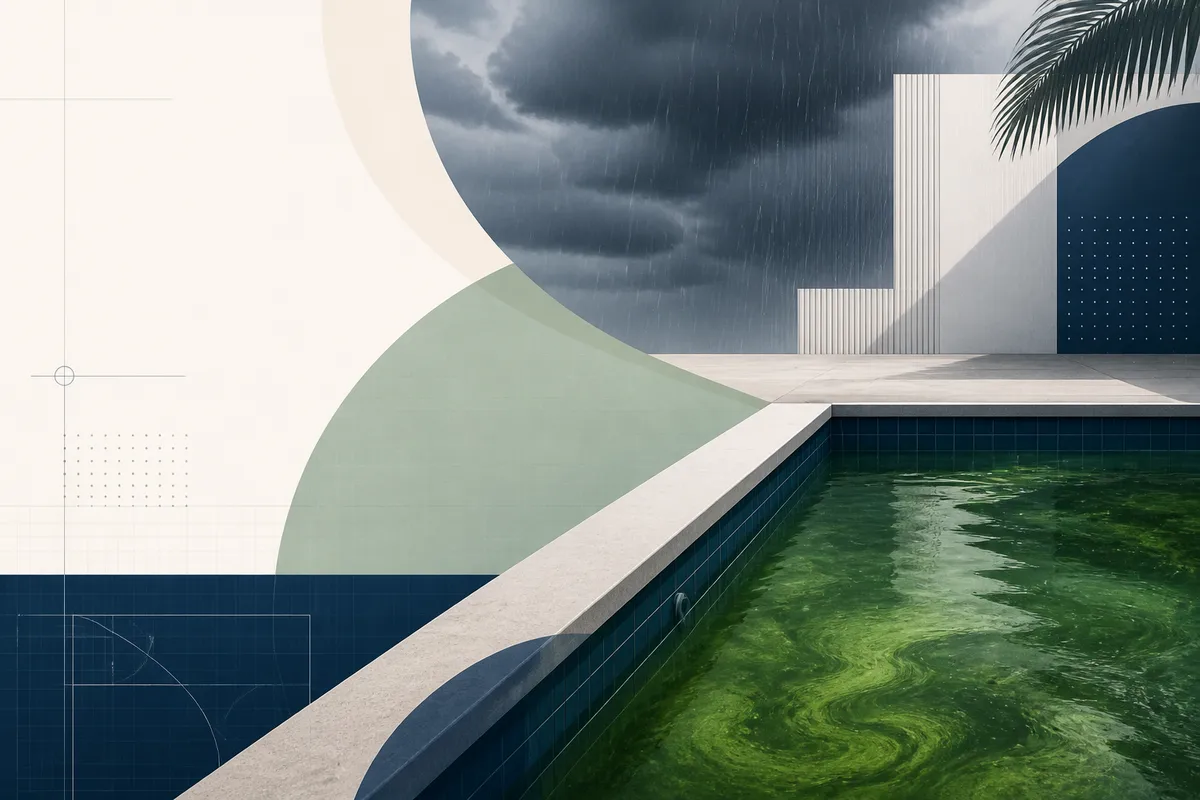
Florida Storms and Algae: Why Rain Turns Pool Water Green
A sudden afternoon downpour in the Winter Park service area does more than just raise the water level. Heavy rains dilute the chemicals and may carry particulate matter from the air, which can raise or lower a pool's pH level (directenergy.com). Most homeowners assume the green tint is just "dilution," but the reality is likely an algae bloom triggered by excess nutrients and debris entering the water (facebook.com).
This guide breaks down the chemical volatility caused by Florida's summer storm cycles. It is designed for residential owners who want to understand why their sanitation failed and how to protect their pool interior from the corrosive aftermath of heavy precipitation.
Why Florida Storms Overwhelm Pool Sanitation
Rainwater is a delivery system for environmental contaminants. When a storm cell moves through, it introduces substances that immediately react with the chlorine.
- Rainwater is essentially untreated water; when a large volume falls into a pool, it dilutes chemicals and can bring in dust and pollen (forum.mavaquadoc.com).
- High-volume runoff carries nutrients from nearby landscaping into the basin, which can trigger rapid algae growth (facebook.com).
- Heavy rainfall disrupts the pool's chemical balance, leading to altered pH levels and diluted minerals (poolwerx.com.au).
- Physical debris like leaves and pine needles introduces organic matter that can stain a finish if not removed promptly.
The Post-Storm Recovery Playbook
Restoring a pool after a heavy weather event requires a systematic approach to chemistry rather than just dumping in excess chlorine. Following these steps helps prevent the need for a full pool replastering due to surface degradation.
1Manage the Water Level Immediately
Excess water prevents the skimmers from functioning, meaning debris stays submerged and decays. Drain the water back to the midpoint of the skimmer mouth to ensure the filtration system can effectively pull surface contaminants into the baskets.
2Clean Before You Chemically Treat
Never add chemicals to a pool filled with leaves and silt. Organic matter will consume the chlorine you add before it can kill the algae, wasting money and leaving the water cloudy. Use a leaf rake to clear the floor and empty all pump baskets.
3Test and Reset the pH Balance
Rainwater can significantly alter pH levels. According to the National Weather Service, local conditions often involve rapid transitions from high heat to heavy thunderstorms, which creates a volatile environment for water saturation levels. Adjust your total alkalinity first, then bring the pH into the 7.4 to 7.6 range.
4Shock the System to Break Chloramines
Once the pH is stable, a high-dose shock treatment is necessary to reach "breakpoint chlorination." This process burns off the combined chlorines (chloramines) that cause the characteristic "pool smell" and ensures the remaining chlorine is free to kill active algae spores.
The Nitrogen and Phosphate Problem
While chlorine kills algae, it does nothing to remove the nutrients that allow algae to return. In Florida, storm-driven nutrients are the primary culprits behind recurring green water. Rain brings in particulate matter from the air, and runoff carries organic debris that acts as a food source for algae.
If a pool remains green despite high chlorine levels, nutrient levels are likely excessive. While geological hazards like sinkholes are common in the region, the immediate concern for pool owners is the debris washed in by rain. High nutrient levels create a "buffet" for algae, meaning you may need to apply a phosphate remover to starve the organisms and prevent a secondary bloom.
How Orlando Pool Resurface helps
When a pool remains green for an extended period, or if the storm runoff was particularly heavy, the resulting algae bloom can leave deep-seated stains in the plaster pores. A professional assessment typically involves checking for etching—where the acidic water has physically eaten away the smooth surface of the pool. In these instances, a service provider will evaluate whether the finish can be saved through a controlled acid wash or if the structural integrity of the plaster requires a full resurfacing. A sound scope of work should always include a full water analysis and a visual inspection of the tile line and coping for signs of water intrusion or delamination.
Frequently asked questions
Can I swim in the pool while it is still slightly green?
Swimming in a green pool is not recommended due to the lack of active sanitation. Algae itself is not usually harmful, but the conditions that allow algae to grow—low chlorine and high bacteria—can cause skin irritation or ear infections. Wait until the water is crystal clear and chemistry levels have stabilized within the standard ranges.
How much rain does it take to ruin my pool chemistry?
Heavy rainfall is enough to significantly shift the pH and dilute the chlorine levels. The impact depends on the volume of the pool; smaller pools or those with large surrounding landscapes that contribute runoff will see faster chemical degradation than larger, screened-in basins.
Why is my pool cloudy instead of green after a storm?
Cloudy water is often the "gray area" before a full algae bloom or the result of fine silt and dust suspended in the water. It indicates that the filter is struggling to catch small particles or that the pH is high enough to cause calcium to precipitate out of the water. Check your filter pressure and consider using a clarifier to help the particles clump together.
Will a salt cell system handle a storm better than a chlorine pool?
A salt chlorine generator still produces the same chlorine as a traditional pool, but it does so at a steady, slow rate. A heavy rainstorm often requires a "boost" or manual shock because the salt cell cannot produce chlorine fast enough to keep up with the sudden organic load introduced by Florida weather.
How do I prevent my pool from overflowing during a hurricane?
Do not drain your pool completely, as the rising groundwater table in Florida can cause an empty pool to "pop" out of the ground. Instead, lower the water level by 12 to 18 inches using the waste or backwash setting on your filter. This provides a buffer for the expected rainfall while maintaining enough weight to keep the shell anchored in the soil.
What happens when you get in touch: you describe the situation, we ask the few questions that actually change the answer, and you get a clear scope and next step — no obligation.